The Clay Convention in Ningxia: Can an 8,000-Year-Old Georgian Qvevri Redefine Chinese Wine?
In the classic Chinese novel Journey to the West, before the monk TANG Sanzang set out for India, Emperor Taizong of the Tang dynasty picked up a pinch of soil and dropped it into the monk's vegetarian wine cup, saying: "Cherish the soil of your homeland above all else."
More than a thousand years later, in the eastern foothills of the Helan Mountains in Ningxia, that sentiment has found a more refined expression. The soil of one's homeland is now formed into clay vessels, and the wines aged within them carry the very taste of that place. On the other side of the world, Georgians bury their clay vessels – called qvevri - in the ground, allowing grape juice to slowly ferment and transform into wine underground. Two ancient civilisations, each with its own dialogue with the soil, united by a shared clay winemaking tradition.
On June 27 and 29, 2026, the National Wine Agency of Georgia and Asia’s leading wine marketing and education firm - Meiburg Wine Media - hosted two landmark events at the Silver Heights Wine Cultural Centre in Yinchuan, Ningxia, which resonated well beyond this dynamic wine region: a flagship masterclass on Georgian wine and qvevri winemaking, followed by a comparative tasting that featured distinct wines made from Georgia’s qvevri and China’s clayware vessels, along with benchmark clay wines from Australia and Austria. Together, they formed a winemaking dialogue spanning 8,000 years – with a view to carry on the tradition for many more to come.

The Clay Threaded Two Ancient Civilisations
Clay and fermented beverages have independent histories in Eastern and Western civilisations that stretch back thousands of years, yet share remarkable parallels. At the 9,000-year-old Jiahu site in China's Henan Province, archaeologists have found evidence of fermented drinks made in pottery vessels. For 6,000 years, Chinese huangjiu (rice-fermented wine) and baijiu (grain-distilled spirit) have been aged in clay jars. As GAO Lin, founder of Silver Heights, puts it, "Chinese people have always used clay pots for pickling vegetables and storing water – it's part of our daily life." China is the homeland of ceramics; the world knows it by that name.
On the other side of the world, Georgia is recognised as one of the birthplaces of wine, with an unbroken tradition of clay winemaking stretching back more than 8,000 years. Its iconic qvevri – an egg-shaped clay vessel – is buried in the ground, where it maintains a constant fermentation temperature. In 2013, Georgia's qvevri winemaking method was inscribed on UNESCO's Intangible Cultural Heritage list.
In Ningxia, the use of clay vessels is diverse. Beyond locally developed stoneware jars, some wineries have sourced vessels from China's traditional ceramic centres such as Rongxian in Sichuan and Jingdezhen in Jiangxi Province. ZHANG Pai, owner of Domaine Charme, made a dedicated trip to Rongxian to research clayware jars, adapting them from their traditional use in baijiu ageing. Ningxia's stoneware – which the Chinese call shiguan – are fired at temperatures above 1,200°C. The Chinese character shi (炻) is composed of the radical for "fire" on the left and the character for "stone" (石) on the right. Shi ware – or stoneware – is a type of ceramic that sits between earthenware and porcelain,it's harder than earthenware, more porous than porcelain, yet unglazed and uncoated on the inside. They are placed above ground and fitted with valves and manhole covers for easy cleaning and standardised operation.
Debra MEIBURG MW captured the spirit of the exchange: "We saw clay as a conversation, a bridge between China's ancient tradition of using clay for fermented beverages, fruit storage and grains, and Georgia’s 8,000-year tradition of clay winemaking."

Debra MEIBURG MW

GAO Lin
The Clay Convention Brought Two Days of Deep Engagement
On 27 and 29 June, the Georgian wine and qvevri winemaking masterclass and the comparative tasting brought together nearly 100 wine professionals, the majority of whom were winemakers and trade professionals based in Ningxia. They presented more than 50 Chinese wines – including clay-aged wines, signature classics, and experimental cuvées – alongside benchmark clay wines from Georgia, Austria and Australia.
The masterclass and tasting were led by Debra MEIBURG MW, joined by an expert panel: Shota NATROSHVILI, chief winemaker for one of Georgia’s largest and most internationally renowned contemporary wineries, Teliani Valley, and his own traditional winery, Ibero; Mike BENNIE, the acclaimed Australian wine writer, critic and presenter; and leading Chinese winemakers Emma GAO (Silver Heights) and Ian DAI (Xiao Pu). They started with Georgia’s wine history, native grape varieties, key regions, and the cultural importance of qvevri, then moved into a more technical discussion of how qvevri winemaking works in practice, including fermentation, maceration, vessel management, lees contact, oxygen exposure, hygiene, aging and style outcomes.
Following the comparative tasting, a roundtable discussion lasted for nearly two hours, with lively exchanges between Chinese and international winemakers, during which they shared technical insights and practical experience. Present at the event were WANG Ziyun, President of the Ningxia Wine Federation; LI Xueming, Vice President; and YI Guotao, Editor-in-Chief of Duzui: Ningxia Winery Guide, together with other representatives from local industry bodies. They had productive exchanges with the visiting guests.

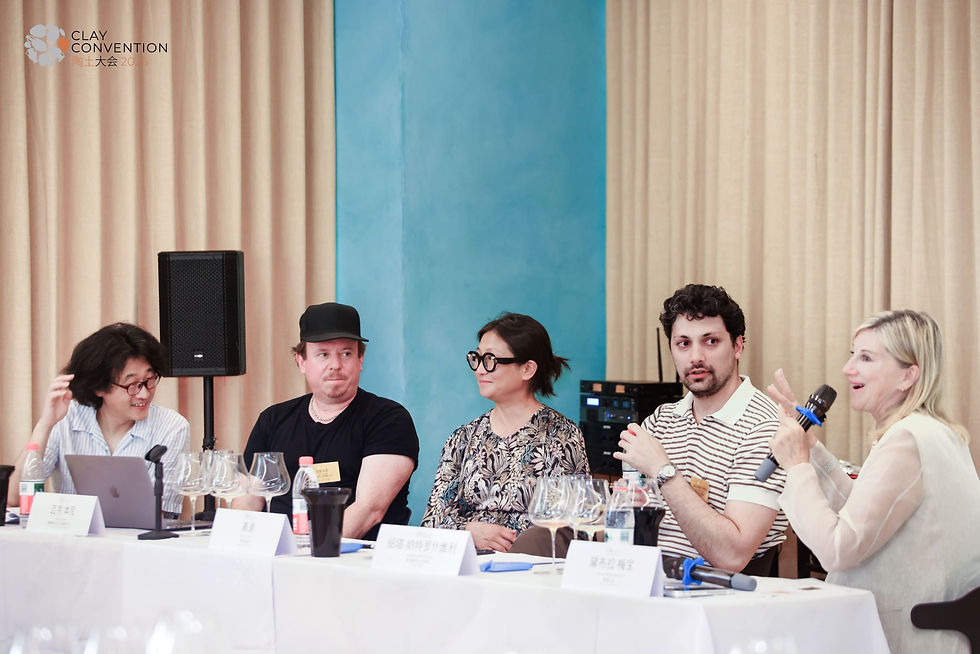
From right: Debra MEIBURG MW, Shota NATROSHVILI, Emma GAO, Mike BENNIE, Ian DAI

WANG Ziyun

Debra MEIBURG MW (left), LI Xueming (right)

YI Guotao


Why Was the Clay Convention in Ningxia?
What makes the eastern foothills of the Helan Mountains such a natural home for the Clay Convention?
LI Xueming, Vice President of the Ningxia Wine Federation, provided some supporting figures, "Ningxia's locally developed stoneware jars are used by more than 50 wineries in this region and over 70 nationwide. Ningxia is rich in clay resources – about 30-40% of China's silicon carbide, a type of advanced ceramic material, comes from the region. And our electricity costs are only about one-third of those in coastal regions, giving us a significant cost advantage."
The visiting wine experts were equally impressed. Debra MEIBURG MW observed, "I've been tasting Chinese wines since 1996, but tasting them here in Ningxia – among the mountains, rocks and desert – gives the wines context and life. I have been just so impressed by the quality of the wines I’ve tasted here. And I've had Marselan before, but to taste it in its purest form - made in these clay vessels, where I can really taste the fruit, the purity and the actual character of the grape - has been eye opening."
Mike BENNIE was equally enthusiastic, "The wines I've tasted in Ningxia are honestly some of the most exciting, interesting and diverse wines that I've tried in recent years. This trip has been really eye-opening in terms of the diversity of wine styles, the potential of this region, and the source of both easy drinking wines and fine wines with real distinction."
Shota NATROSHVILI noted, "This trip was a great discovery for me because I see a huge progress that Chinese winemakers have made throughout these last few years." After visiting a local clayware workshop, he added, "We also visited the production of the clay vessels themselves, and it was quite interesting to see how they quickly switched from making the clay vessls for different purposes to specifically making clay pots for the wine, and how they mix this clay and scientifically determine what works best for this area, so I think there's a lot of potential in this direction."
Ian DAI offered his own tasting impressions, "Ningxia clay-aged wines show a touch of minerality, more prominent fruit, brighter acidity and lower alcohol. Ningxia is generally a region with ripe fruit, modest acidity and not much minerality, but in clay-aged wines these characteristics become clearly noticeable."
I have visited Ningxia four times since 2015, and each time I have seen the region's wine quality rise further – it is now world-class. The younger generation of winemakers, many of whom have had formal winemaking education, showed stylistic visions and distinctive interpretations of their wines – a confidence that was particularly striking during the comparative tastings.
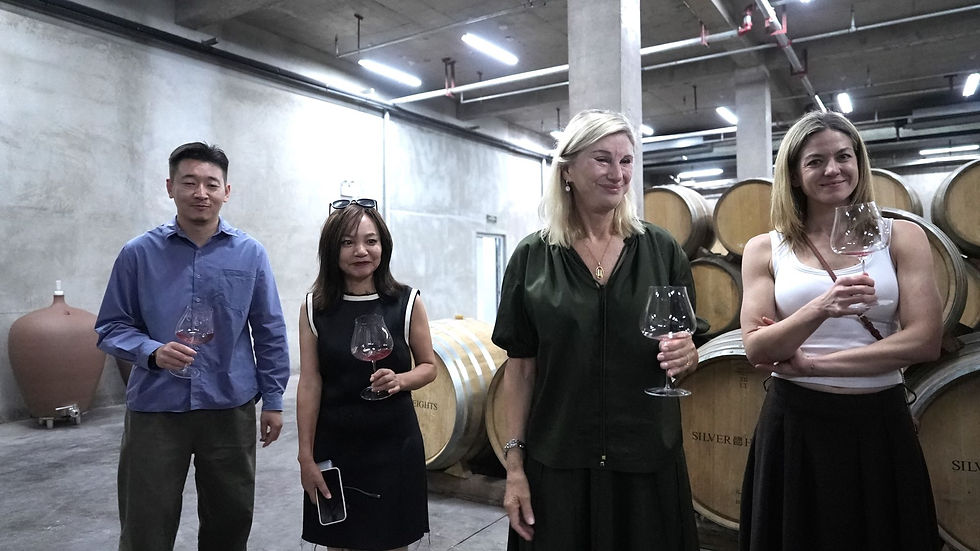
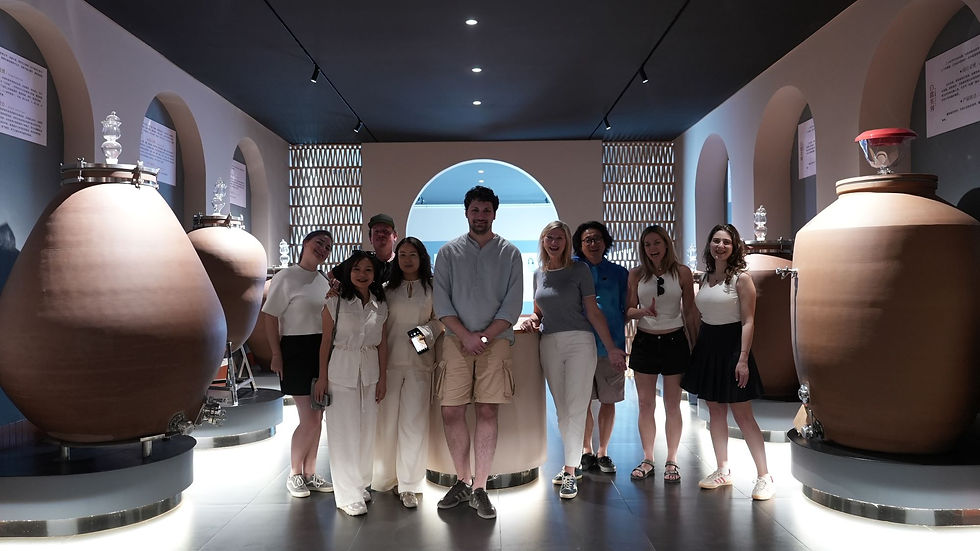
During their stay, the international wine experts also visited a number of Ningxia's leading wineries: Silver Heights, Helan Qingxue (Jiabeilan), Xige, Huahao, The Starting Point (Yuandian), Charme (Xiamu), Mountain Wave (Haiyue Renhe) and Devo. They also toured the Western Xia Imperial Tombs and the stoneware jar manufacturer Magic Bird, gaining a deeper understanding of Ningxia's terroir, culture, winemaking practices and clay vessel production.




The Common Ground and Key Differences Between Georgia and Ningxia
The wine experts identified both shared values and striking contrasts between the two countries' clay winemaking traditions.
According to Shota NATROSHVILI, "One key difference I can point out straight away is that in this area, they are mostly focusing on the red wines in clay vessels, meanwhile in Georgia we work a lot with white grapes and skin contact whites."
Debra MEIBURG elaborated, "In Georgia, the clay containers are buried in the ground and this is done for temperature control during fermentation, and the ability to protect the containers. Here in China, we see the containers being used above ground, being prepared in a way that incorporates modern equipment like valves for easier use in production." She added: "Georgia has a longer history of fermenting white grapes in clay containers with skins for longer periods of time – from three weeks up to eight months. So far, here in Ningxia, I see shorter skin contact that makes the wines perhaps a little easier to approach."
Similarly, Shota noted, " I would say it is clear that Chinese winemakers use clay vessels as a way of preserving the aromas of the wines, as well as the purity of the grape variety. This can be clearly seen throughout the spectrum of clay-aged wines from across the region."
Mike BENNIE also saw the connection, "Georgia obviously leans into very traditional wine styles, particularly robust amber wines. China's burgeoning scene with clay winemaking sees lighter, fresher styles of orange wines. But there's a connection between the two countries – in their winemaking philosophy and in the vessels in which those wines are produced."

Mike BENNIE

Debra MEIBURG MW
How Georgia's Ancient Tradition Inspires Ningxia, the Emerging Wine Region?
Georgia's 8,000-year unbroken clay winemaking tradition is an invaluable refernce for Ningxia.
Shota NATROSHVILI shared practical knowledge, "Georgia has a complete set of winemaking practices for clay vessels. There are specialised tools for cleaning; we use ash or mineral powder on the inner walls to prevent mould, and we dry them with blowers. These are techniques handed down through generations."
Emma GAO, owner of Silver Heights, said, "Shota is from three generations of winemakers. The experience he shared with us is something we simply didn't know. It's been incredibly valuable."
Debra MEIBURG MW added, "Georgia has been making wines with this qvevri winemaking tradition for 8,000 years", showing that such persistence itself is an inspiration.

Shota NATROSHVILI

Emma GAO
Is Clay-Winemaking China's 'Game Changer' in International Markets?
Shota NATROSHVILI's answer was characteristically direct, "I think in China it can be a game changer in that it can help Chinese wine culture to establish itself on the international market. I think clay vessel is a very natural product for Chinese culture in general, it can also be fully integrated into wine culture. And it feels more natural than an oak barrel. I think China could emphasize more in this direction and it can be one of the selling points, or icebreakers into the international market. "
Ningxia winemakers' experiences support this.
Emma GAO of Silver Heights said, "We export to more than 20 countries, and clay-aged wines account for 25-30% of our production. They're not flashy, they’re not overly manipulated, they express terroir, and they're not homogeneous."
ZHANG Pai, owner of Domaine Charme, noted, "Oak aging is like putting makeup on wine. Clay is completely natural – it presents the grape's most authentic aromas and flavours."
ZHANG Jing, winemaker and co-owner of Helan Qingxue (Jiabeilan), who made her first clay-aged Chardonnay experiment last year, observed, "The wine is more vibrant, and the style is more natural."
LIAO Zusong, winemaker of Xige Estate, sees clay winemaking as a complete Chinese wine narrative, "Chinese grapes + Chinese winemaking vessels + Chinese culture." Christelle Chene, Xige's Global Brand Ambassador, added from a market perspective, "Clay-aged wines are a valuable addition to our existing wine category, offering consumers another choice and making it easier to engage in conversation with them."
LI Jing, owner of Mountain Wave, stated, "Clay-aged wines show very prominent floral and fruit aromas, excellent minerality, and are very different from oak-aged wines, offering a remarkable point of difference in the market."
YE Meilin of Magic Bird Ceramics explained the uniqueness of her "terroir stoneware jars": "The absence of coating is our biggest advantage. The oxygen permeability is slightly lower than oak, which maximizes the expression of the grapes' natural aromas and flavours." She highlighted the unique "terroir core" inside the stoneware jar, which offers winemakers three flexible options: using the stoneware jar alone; adding the terroir core; or combining both with oak planks of different toast and origins. This, she explained, allows for a dialogue with winemakers while also appealing to consumers who appreciate a subtle hint of wood character.
LI Xueming concluded, "Georgia's clay winemaking philosophy offers a solution to the problem of homogeneity, inspiring us to explore wines that truly reflect Ningxia's terroir."
Ian DAI observed from the perspective of a Chinese winemaker, "For wineries producing less than 50,000 bottles a year, clay vessels are ideal – they allow for more batches and more hands-on winemaking, and I imagine many more Chinese wineries will adopt clay as their ageing vessel of choice."

Ian DAI

ZHANG Jing

ZHANG Pai

LIAO Zusong

Christelle Chene (right)

LI Jing

YE Meilin

LI Xueming
Not Just Revival – A New Beginning
Debra MEIBURG MW noted, "It was really only Georgia that kept this clay winemaking tradition alive. I see this incredible use of clay containers in China, in Austria, in Bordeaux, and even in Napa Valley - and around the world in top wine regions - as a revitalization of an ancient technique that we need to protect, not only because it's ancient, but because these containers actually showcase what a grape variety can truly express without adding flavour, but simply letting the grape variety show with minerality and earthiness that bring us back to nature. I just visited Château Lafite Rothschild and Château Latour this month – and even these classified growths are experimenting with clay vessels. With global warming, clay helps preserve freshness and character in wines."
Shota NATROSHVILI added, "Clay vessels should be one of the key interesting aspects that China should emphasize on. But also of great importance are practices in the vineyards, and experimenting boldly with new varieties – particularly those that are adaptable to China’s climate and regional challenges - and perhaps introducing new varieties for clay vessels.”
The Clay Convention in Shanghai: The Next Chapter
The Clay Convention will continue in Shanghai on 9 November 2026, on the eve of ProWine Shanghai. The event will bring together winemakers from around the world for in-depth discussions on the status and role of clay vessels. It will feature comparative tastings of clay-fermented and clay-aged wines from an expanded range of countries, with increased participation from industry experts and guests.
From the Tang emperor's pinch of soil in a rice-wine cup to the Ningxia winemakers who now seal their soils in clay to make wine, the Chinese bond with the land has never wavered. Georgia's 8,000-year unbroken clay winemaking tradition provides the most invaluable historical reference for Ningxia's journey of discovery. The clay vessels of the Helan Mountains' foothills carry not just Ningxia's terroir, but the confidence and ambition of an ancient winemaking civilisation finding its own voice – and offering it to the world.
留言